
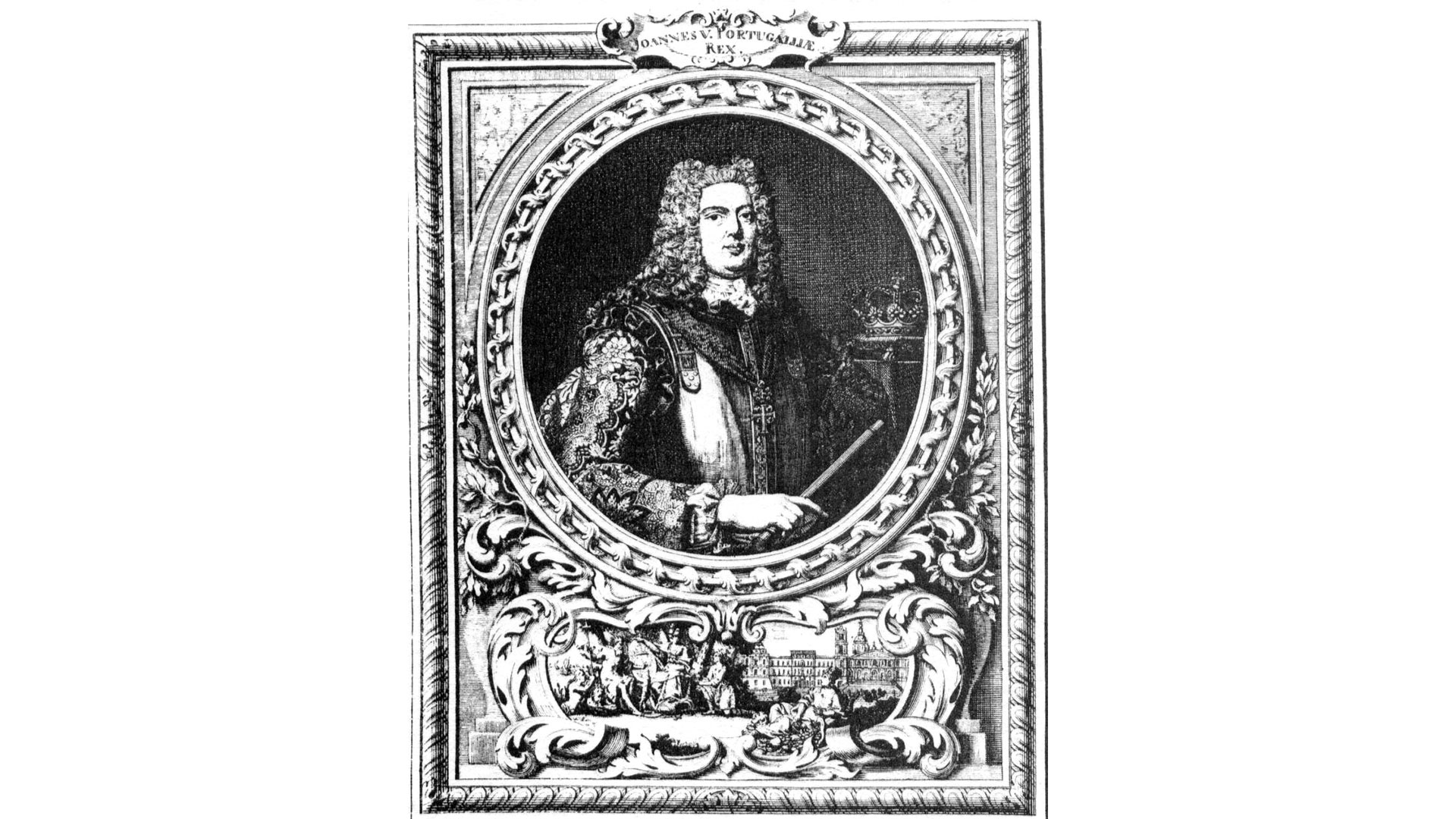
Dom JOÃO V - (22 October 1689-31 March 1750)
João Francisco António José Bento Bernardo de Bragança. He was the son of Pedro II and his second wife, Maria Sofia de Neuburg. Married on 9 June 1708 to D. Mariana of Austria (Linz, 7 September 1683 † Palácio de Belém, 14 August 1754).
He reigned between 1706 and 1750. As many of his actions and choices testify, he was the last Portuguese monarch aware of the national Millenarianism tradition. The division of Lisbon into twelve neighbourhoods and these into two hemispheres, East and West, like Rome (1716), the creation of the Patriarchal Church of Lisbon (1716), the Royal Work of Mafra (1717) and the Águas Livres Aqueduct are the result of such enlightened visionaryism.
ROYAL WORK OF MAFRA
1711King João V's charter states that "for just reasons", he decided to build a monastery for the Arrábida monks near Mafra.
1712
Late - The disagreement over where to build the Royal Work led King João V to travel from the Palace of Sintra to Mafra to examine the land, deciding on the site known as Vela, to the east of the town and at an altitude of 234 metres.
1717
November 17 - Laying of the foundation stone of the Royal Work of Mafra, attended by the Royal Family, the Court, the Patriarch of Lisbon and his entourage, a priest of the Society of Jesus, a Provincial and 66 religious members from the Province of Arrábida, parish priests, clergymen, the local judge and councillors, organists, musicians, singers, cavalry and infantry forces. "80,000 réis were spent on this feast. On this day, the King gave dinner to all the people and the troops" (Conceição Gomes, 1894, p. 75).
1722
December 10 - The Lisbon Gazette reports on King João V's visit to the Mafra works the previous Thursday.
1725
Botanist Merveilleux reports that the demolition of the 2nd project of the Royal Centre is underway.
1727
Once the building of the third project had been demolished, the Magnanimous One ordered the construction of the fourth and final project of the Royal Work, entrusting Custódio Vieira with the management of the work.
1730
22 to 29 October - Octave of the Sagration of the Basilica of Mafra. The ceremonies begin on the 22nd, the 41st birthday of King João V, officiated by the Patriarch of Lisbon, and the temple is dedicated to the Blessed Virgin and St Anthony. The solemnities will continue for a week, concluding on 29 October. In addition to the Royal Family, several gentlemen accompany the King due to his Ministries; others who are part of the Court, the Ecclesiastical Court, members of the Patriarchal Curia, presbyteral canons, the Regular Court, religious who do not have Provinces in the Kingdom and others from the Kingdom's eight Seraphic Provinces.
Dona Maria Ana de Áustria (Linz, 7.9.1683-Lisbon 14.8.1754)
She married King João V on 9 June 1708. The following children were born of the marriage:
D. Maria Bárbara Xavier Leonor Teresa Antónia Josefa (Lisbon, 4/12/1711 † Madrid, 27/8/1758)
D. Pedro (Lisbon, 19/10/1712 † 29/10/1714)
D. José, who succeeded to the throne (6/6/1714 † 24/2/1777)
D. Carlos (Lisbon 2/5/1716 † 30/3/1720)
D. Pedro Clemente Francisco José António, later Pedro III, by marriage to his niece Maria I (Lisbon, 5/7/1717 † Palácio da Ajuda, 25/5/1786)
D. Alexandre Francisco José António Nicolau (Lisbon, 24/9/1723 † 2/8/1728)
D. João V also had the following illegitimate children:
D. António (Lisbon, 1/10/1704 † 14/8/1800), son of Luísa Inês Antónia Machado
D. Gaspar (Lisbon, 8/10/1716 † Braga 18/1/1789), son of D. Madalena Máxima da Silva Miranda Henriques
D. José José (Lisbon, 8/9/1720 † 31/7/1801), son of Mother Paula Teresa da Silva (known as Meninos de Palhavã because they were brought up in the Palace of the same name)
D. Maria Rita, who was born and died on an unknown date, was the daughter of D. Luísa Clara of Portugal
CARILLON
It's known that the first keyboard carillon was built by the Consistory House of Alost (Belgium) around 1487, followed by those in the cities of Dunkirk, Cambrai, Dijón, etc. As for Portugal, there is little news to clarify exactly when they existed. In any case, no carillon ever reached the importance that the ones in Mafra would assume, especially since King João V not only acquired two complete sets but also because they were the heaviest on record. Their installation began a few months before the Basilica was consecrated, on 22 October 1730, so only the instrument in the North Tower was used in the ceremony, and even then, it was incomplete, as not all the bells had arrived.
The sound quality of the 46 bells of the South Carillon is far superior to the temperament of the 44 of the North. These were cast in Antwerp by Willem Witlockx, according to the inscription they bear: "GUILHELMUS WITHLOCKX ME FECIT ANTUERPIA ANNO DOMINI MDCCXXX". Those of the North Carillon are the work of the Liège foundryman, Nicholas Levache, attested to by the legend: "NICOLAUS LEVACHE LEODIENSIS ME FECIT ANNO DOMINI MDCCXXX".
Before being taken to Mafra, the Patriarch of Lisbon consecrated the bells in Santo Antão do Tojal, where they had landed. The complex ceremony involved, as liturgical practice dictated, blessing, baptism, anointing with the attribution of patronymics, fumigation with incense and the reading of the Gospel of St Luke in the passage describing Jesus' visit to Martha and Mary (X, 38-42).
