
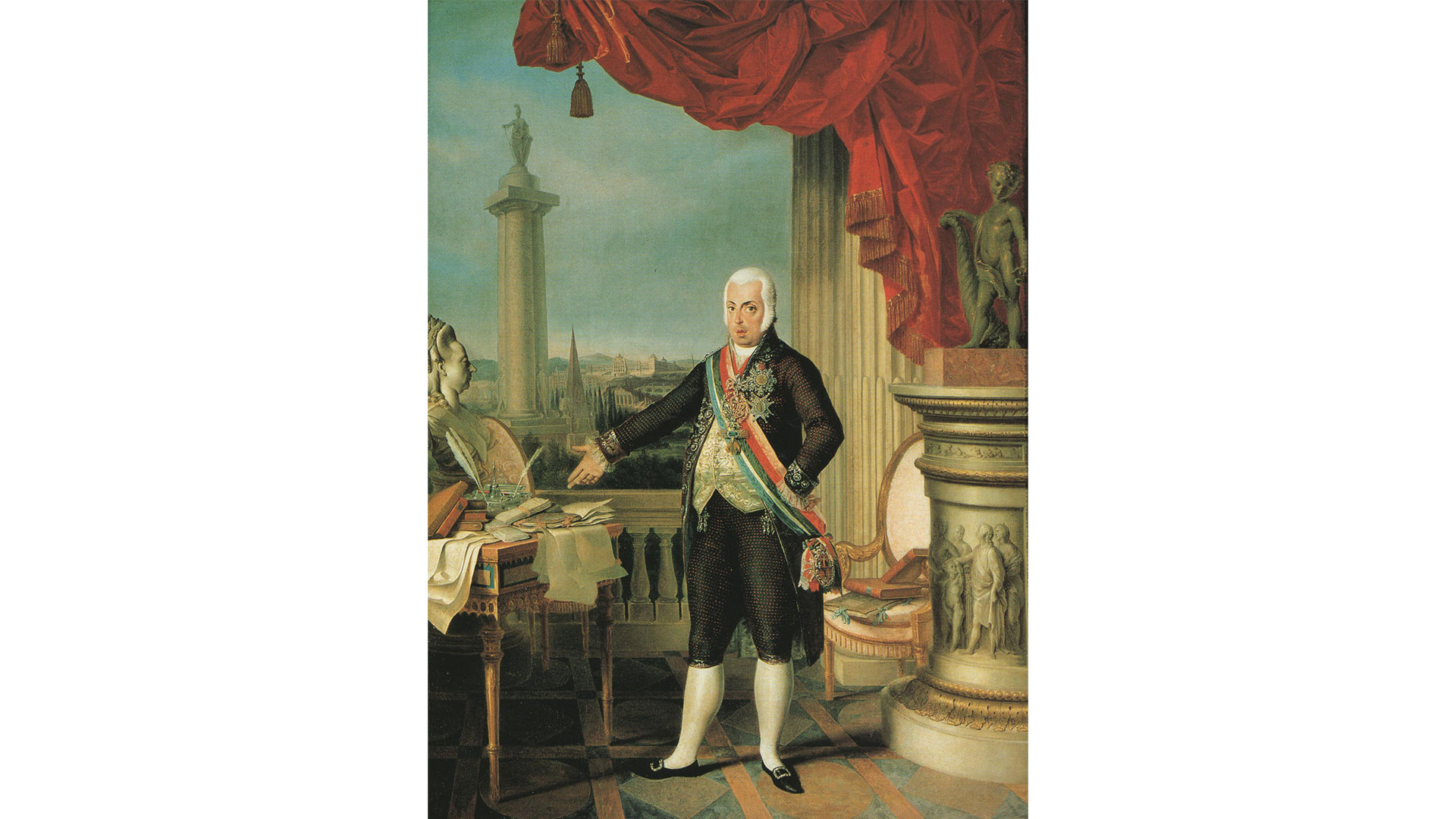
Dom JOÃO VI - (13.4.1767-10.3.1826)
D. João Maria José Francisco Xavier de Paula Luís António Domingos Rafael de Bragança. Son of Maria I and Pedro III.
He married Carlota Joaquina on 8 May 1785, who was born in Aranjuez on 25 April 1775 and died at the Palace of Queluz on 7 January 1830. As he wasn't expected to become king, he was never given much attention. The popular epithets are enlightening as to his bonhomie, which, moreover, made him loved by his vassals: El-Rei-o-Nada; Caconso; Bonacheirão; Beato (he loved church festivals, appeared as a judge at some, learnt the cantata). He became Regent due to his mother's illness (1791), and he moved the Court to Brazil (1807) to avoid being taken hostage by Napoleon, as had happened with the Spanish Court. On the death of Queen Maria I, he was acclaimed King in Rio de Janeiro on 6 February 1818. Gifted with a spirit of economy (learnt from the friars and the locals), clever (Herculano classifies his cleverness as local), ironic, breezy and melancholic (in Mafra, "the locals were dying for the Infante, they invited him to be godfather to their children"; "the locals he cultivated offered him fat chickens").
Francisco de Carvalho Brito Gorjão wrote about this:
"[...] King João VI had great popular sympathy in Mafra, where he liked to be: I remember my father telling me that he was a child when King João VI came to Mafra for the first time, after returning from Brazil, but that he would never forget the extraordinary enthusiasm with which he was received, the people crying and the women with their children on their laps, when he passed by in the chariot, pulled by his loyal subjects, who had removed the mules to gloriously replace them! Three years after the marriage was consummated (1790), Prince João put up with his wife with difficulty, leaving her completely free. It was said then that "there had never been such a badly married king or court in Portugal". Tradition has it that King João VI was an excellent gastronome.
Dona CARLOTA JOAQUINA
(25.4.1775-7.1.1830)
Infanta of Spain, daughter of Charles IV, Prince of Asturias, and Maria Luisa Teresa of Parma. She was married at the age of 10 to the then Infante Dom João, son of Dona Maria I, then Regent in her name (1792) and finally acclaimed as Dom João VI.
Intriguing by nature, in 1806, with the connivance of some noblemen, namely the Marquis of Ponte de Lima, she organised a plot to dethrone the Regent, her husband, which would become known to posterity as the Mafra Conspiracy (Broccoli with chocolate). When the Royal Family took refuge in Brazil in 1808, she had to fuel an intrigue to become queen of the Spanish colonies since her brother had been forced to abdicate in favour of a suitor supported by Napoleon.
Once she returned to Lisbon in 1821, she refused to swear to the Constitution and conspired with her son Dom Miguel to seize the throne, even after the death of Dom João VI in 1826, becoming responsible for the civil war that was to oppose the parties of the legitimate heir, Dom Pedro, and Dom Miguel, his favourite.
D. António Pio (1795-1801) - Prince of Beira, died as a child.
D. Maria Isabel Francisca de Assis Antónia Carlota Joana Josefa Xavier de Paula Micaela Rafaela Isabel Gonzaga (19/5/1797-29/11/1818) - Queen of Spain, married on 6 September 1816 to her maternal uncle, Ferdinand VII, King of Spain.
D. Pedro de Alcântara Francisco António João Carlos Xavier de Paula Miguel Rafael Joaquim José Gonzaga Pascoal Cipriano Serafim (12/10/1798-24/9/1834) - Pedro I, Emperor of Brazil (1822-1831) and King of Portugal (1826).
D. Maria Francisca de Assis da Maternidade Xavier de Paula de Alcântara Antónia Joaquina Gonzaga Carlota Mónica Senhorinha Soter e Cacia (22/4/1800-4/9/1834) - Married her maternal uncle, Carlos Maria Isidro, on 6 September 1816.
D. Isabel Maria da Conceição Joana Gualberta Ana Francisca de Assis Xavier de Paula de Alcântara Antónia Rafaela Micaela Gabriela Joaquina Gonzaga de Bragança e Bourbon (1801-1876) - constitutional regent.
D. Miguel Maria do Patrocínio João Carlos Francisco de Assis Xavier de Paula Pedro de Alcântara António Rafael Gabriel Joaquim José Gonzaga Evaristo de Bragança (26 October 1802-1866) - alleged son of the Marquis of Marialva, Pedro.
D. Maria da Assunção Ana Joana Josefa Luísa Gonzaga Francisca de Assis Xavier de Paula Joaquina Antónia de Santiago (1805-1834).
D. Ana de Jesus Maria (1806-1857) - Infanta Saloia, alleged daughter of João dos Santos, steward of Quinta do Ramalhão - her mother's favourite.
ORGANS
The organ, adopted by Baroque piety as a princely instrument, capable, like few others, of enhancing the virtues of liturgy, ritual, pomp and circumstance, could not leave the Magnanimous indifferent. By endowing the Basilica of Mafra with six organs, the Portuguese monarch transformed the Sanctuary of the *New Jerusalem into a unique place, in fact, the only one in the whole world that has the privilege of captivating sensitive souls to the Empyreum through such a mass of sound. An organist and various other musicians participated in the laying of the First Stone (*Foundation Stone) of the Mafra Monument (17/11/1717).
The organs of the Basilica of Mafra were generally used in conjunction with cantata, as can be seen from the Accompaniments to masses, sequences, hymns, and more cantata, which is the use and custom to accompany the Organs of the Royal Basilica of Our Lady, e Santo António, junto à Villa de Mafra, with the transport and harmony, by the most convenient means, for the chorus of the same Royal Basilica (Lisbon, 1761), by Friar José de Santo António, first Organist and Master of Music at the Royal Convent of Mafra.
The replacement of the Joanine organs in the Basilica of Mafra began in August 1792. António Xavier Machado e Cerveira, Machado de Castro's half-brother and administrator of the Royal Organs of Mafra, was entrusted with the task. The organ cases of the Gospel (North) and Epistle (South), the two most important of the six sets in the Basilica, were built in Brazilian rosewood between 1799 and 1806. Lord Byron considered them "the most beautiful of his knowledge".
