
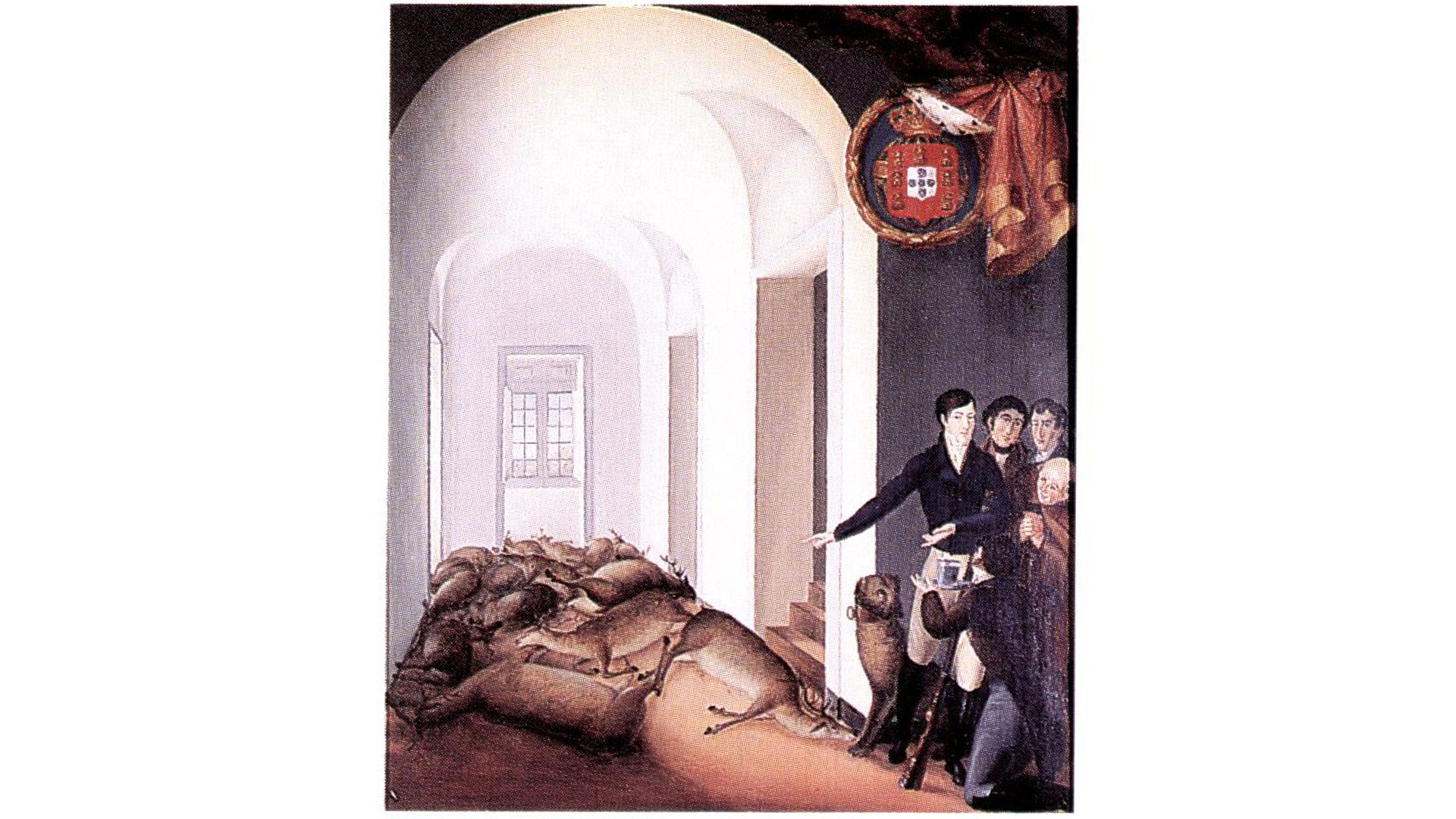
Dom MIGUEL I - (26.10.1802-14.11.1866)
Miguel Maria do Patrocínio João Carlos Francisco de Assis Xavier de Paula Pedro de Alcântara António Rafael Gabriel Joaquim José Gonzaga Evaristo de Bragança. Seventh son of João VI and Carlota Joaquina. He reigned from 30 June 1828 to 26 May 1834. In 1851, he married Princess Adelaide Loewenstein Rosenberg (3 April 1831-16 December 1909). This prince, whose first name (Miguel) was "considered a heavenly inspiration, since he had been drawn by lot three times" (A última Corte do Absolutismo, Lisbon, 1893, p. 183), spent some of his youth in the Palace of Mafra. His quarters were on the second floor of the north façade, in the rooms adjoining the turret. With a playful temperament, he was often found in the kitchen preparing stews and savouring the delicacies he made himself: "Yesterday morning, I was on my way with Father to fetch the Marquise of Angeja from her room. Infante, who had been making stews and was eating them, I went inside where the Marquesa was lying on the bed not knowing how she was going to get dressed or how she was going to get out of there [...]" (idem, p. 277-278). Alberto Pimentel also tells us that one day King Miguel imagined an extravagant tournament with the ladies of the Court, in the "very long corridors" of the Palace of Mafra: "he [on horseback] set off with a lit torch, in the opposite direction to the ladies on donkeys. They held up spindles laden with flax oakum, which he had to set alight as he passed by" (idem, p. 259-260). In other circumstances, according to a letter written by one of these ladies and dated Mafra, on 16 October 1824: he was "bullfighting through the galleries [...]", or strolling around the Palace "dressed as a woman". In October 1859, King Miguel visited Mafra incognito, accompanied by his Austrian friend Franz Weber, to personally express his condolences to King Pedro V on the death of Queen Estefânia. Tomás de Mello Breyner states in his Memórias (Lisbon, 1930, p. 182) that in 1885 he met some of the "Senhor Infante's" confessed admirers, a large number of whom owned his vera effigie, which they carried in their pockets or worshipped at home in an oratory.
He also emphasises that "Don Miguel treated all his servants very well, remembering their names, their children and even their dogs. He was very generous. He would enter the peasants’ houses, chat with them, and savour their cornbread and piquette (a low-alcohol wine made from the second pressings of grape pomace). He was either wearing a uniform or a brioche suit and a camel's cloak."
Despite having sworn in the Constitutional Charter (2 August 1826), Pedro IV's memoirs are almost non-existent in Mafra, completely obliterated by his brother's popularity.
Letter forever excluding the former Infante D. Miguel and his descendants from the right to succeed to the Crown of the Kingdoms of Portugal, the Algarves and their Dominions and banishing them from Portuguese territory Palácio das Necessidades, 19 December 1834
The Banishment Law was reinforced with the promulgation of the 1838 Constitution, article 98, which stipulated that "The collateral line of the former Infante Dom Miguel and all his descendants are perpetually excluded from succession". However, in 1842, this Constitution was revoked, and the Constitutional Charter of 1826 was restored, which did not contain any clause excluding the Miguel branch. Nevertheless, the former Infante Miguel and all his descendants remained in exile until the second half of the 20th century.
After the establishment of the Republic, the Proscription Law was passed (15 October 1910), which forced the exile of all branches of the Portuguese Royal Family.
The Banishment Law was only repealed by the Portuguese National Assembly on 27 May 1950, allowing the descendants of the former Infante D. Miguel to return to Portugal, as well as the descendants of the House of Bragança-Saxe-Coburgo-Gota and the House of Loulé.
