
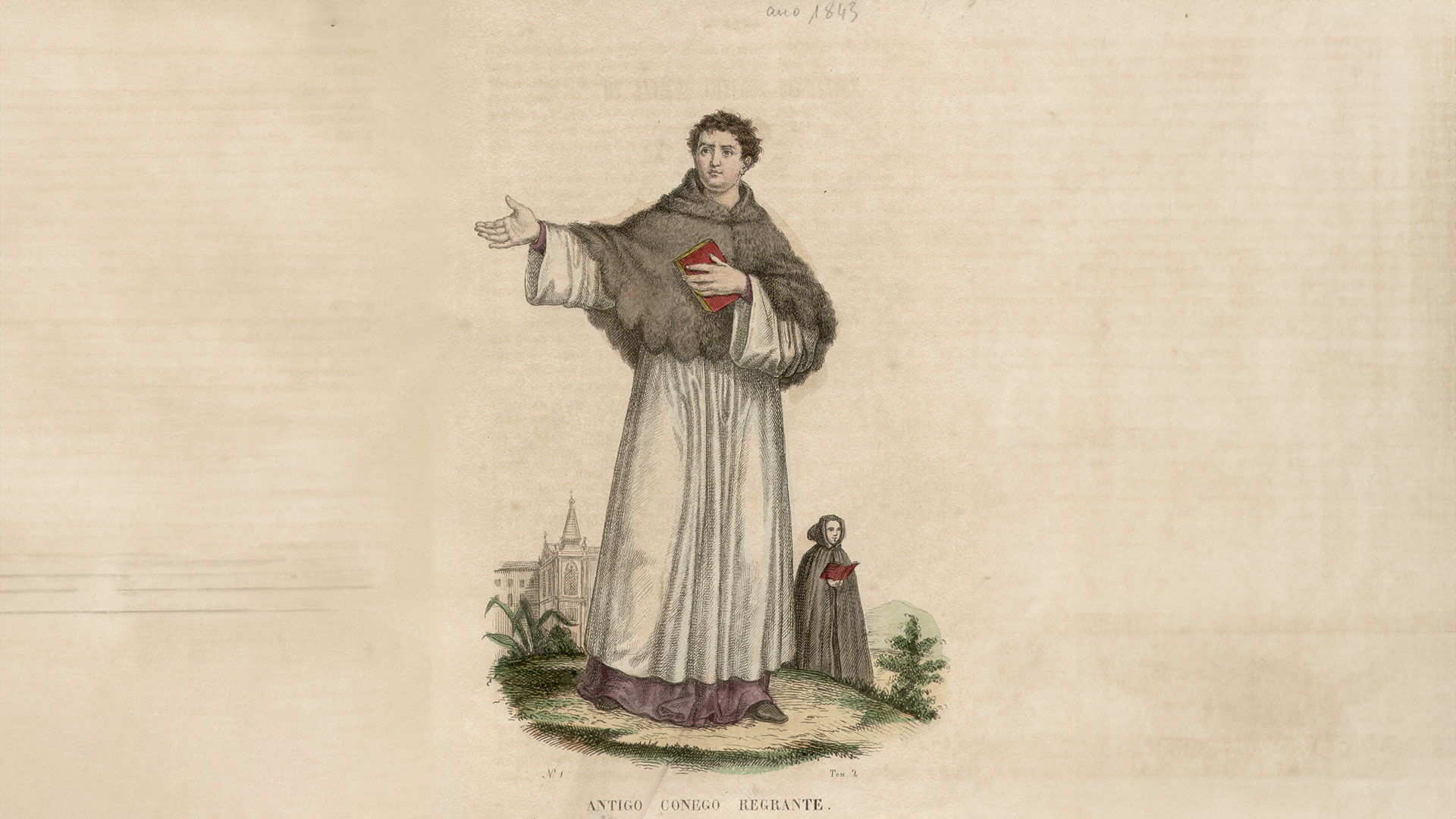
CANONS REGULAR OF SAINT AUGUSTINE
They were also known as the Canons Regular of St Augustine. It was from the Acts of the Apostles and the example of St Augustine that the Canons Regular drew the archetype of life in common and the absence of property. They differed from monastic conceptions because of their evangelising and assistance work. Unlike the monks, they wanted to integrate their behaviour into the institutions and respond to the spiritual aspirations of society, giving priority to preaching, which corresponded to Augustinian praxis. Santa Cruz de Coimbra, the first monastery of the Canons Regular of St Augustine in Portugal, was part of the movement that extended the Reformation promoted during the papacy of Gregory VII (1073-1085), aimed at counteracting the crisis that had been undermining the secular clergy with practices such as simony (the buying or selling of ecclesiastical privileges, for example, pardons or benefices) and other abuses. After Clement XIV published a brief (1770) suppressing the monasteries of São Salvador de Grijó, Vila Boa do Bispo, São Martinho de Cáramos, Santa Maria de Landim, São Salvador de Paderne, São Simão de Junqueira, São Jorge (Coimbra), Santa Maria de Refoios de Lima and Moreira monasteries of the Canons Regular of Saint Augustine, uniting the respective revenues and applying them to the Royal Convent of Mafra of the Royal Patronage, which was then "granted and signed" to the same Canons. They took possession of the convent of Mafra on 3 May 1771.
The Canons remained there until Dona Maria's decision of 12 May 1792, when the queen ordered the Arrábida monks to replace them.
Since 1777, the Canons Regular had spent 24,084 ‘réis’ on the Mafra National Palace Library, not including the architect Manuel Caetano de Sousa's wages, estimated at 1,800 ‘réis’. In 1834, on the eve of the extinction of the Religious Orders in Portugal (28 May), the Canons Regular had episodically reoccupied the convent of Mafra.
Meanwhile, by decree of 21 January, signed by the Duke of Bragança, Dom Pedro, on behalf of Dona Maria II, the Cardinal-Patriarch of Lisbon obtained authorisation to request, for use in the church of the monastery of São Vicente de Fora, the implements, sacred vessels and utensils from the depository of the convent of Mafra.
